
THE WALK BOOK *FULL LORE*
1000 COPIES OUT NOW FOR $0

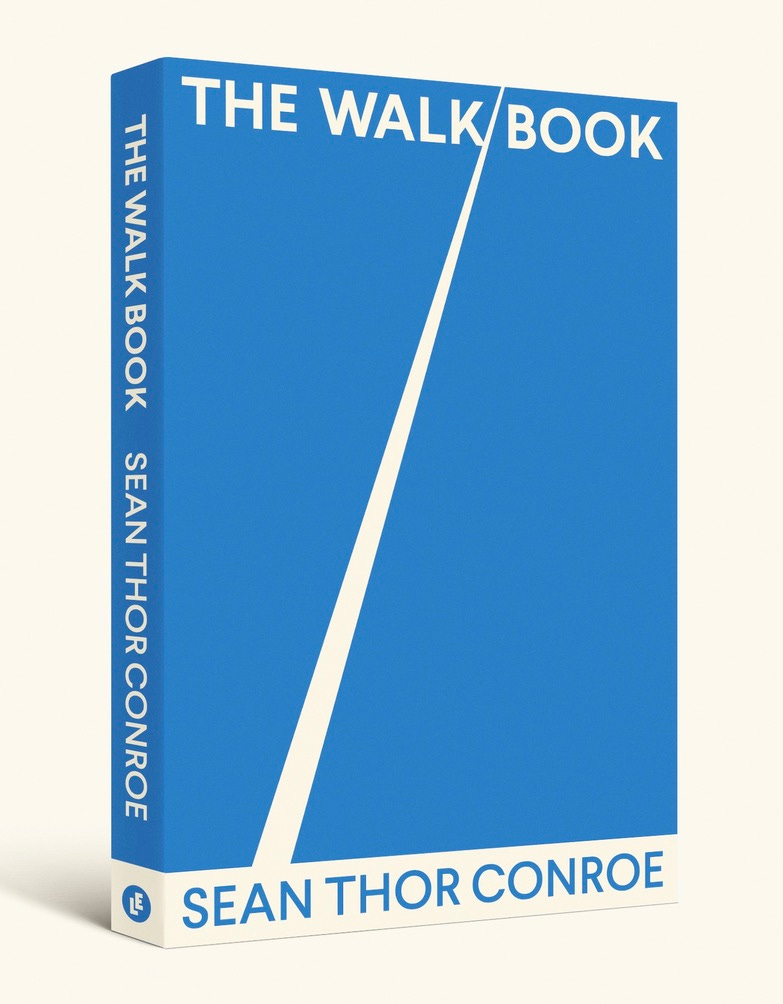
It’s Monday, 6.22.26, almost 1 PM, and as of an hour ago, the legendary music agent and writer and publisher and now damn PHILANTHROPIST OF THE ARTS Adam Voith is busy at work shipping out 1000 copies of my book THE WALK BOOK, which I’ve worked on and off on for over a decade, and which was excerpted in Issue 246 of The Paris Review, to the first 1000 people to click ORDER (for a whopping ZERO DOLLARS) on the littleengines [dot] shop website.
Last he texted me, over half of them are gone.
I thought I’d take a sec to break down the full lore of this book.
~
INITIAL INCEPTION
The short and direct of its initial inception was, all of 2013, my last year of undergrad, I was cooped up in the top floor closet room of the off-campus student house at Swarthmore College, “The Barn,” which cost $275/month, and which you could blast cigs inside in, which I spent all year doing, almost fully nocturnal, psychotically stimulanted. I already had a full “need-based” ride, but I’d “dropped out” the previous spring, after my junior year, when my then girlfriend, who was a year older, graduated, before returning after a semester: I was working at a coffee shop, reading all of Bolaño, and trying to write a novel; after a few months doing that, I realized I could just return to school and do that there. In school.
And so that’s what I did for all of 2013, starting in January. I drove back across country from California to Philly with my girlfriend, in the freezing snow, she got an apartment in West Philly, and I re-enrolled for my final year—but offset, given I’d taken that semester off. I made up a “self-directed thesis project”—to read all of Bolaño, chronologically, over one calendar year—and did a year-long “creative writing thesis. I even got a “research grant” to keep working on the project over the summer.
Somewhere deep down I knew, however, as the year progressed, and I more fully understood Bolaño’s message, that I was eating off the system and writing a nonsense project, disconnected from my own voice, from the streets, from the world.
It was sometime during that fall, when my bloated Bolaño book ballooned out of my control, and my novel spiraled in pointless, frivolous directions, that I got this idea of a new project: to walk all day, every day, sleep wherever I ended up; to say and write no words unless I encountered something tangible, in the world, outside of the cloistered institution, related to my real-life survival, worth telling about. My view of literature has always been almost barbarically literal, I think I inherited a ramped-up nervous system from both my mother’s Japanese side, her father was the only survivor in his family, along with his father, in the Tokyo Bombings, and also on my father’s side, filled with stoic toxic military men (which I say with love), and would often go full nocturnal, unable to sleep, neurotically fixated on some new task that would save me, with catastrophic consequences for my relationships and my ability to function in society. Writing and reading, then, for me, has always been inextricably tied to calming myself down, temporarily making my body inhabitable, the world bearable. Given all this, I was primed, in my way, to engage in this belligerent quest.
Starting in March of 2014, I walked all day every day for 100 days, from Philly to La Junta, Colorado.
~
EARLY WALK BOOKS
As early as age seven, when I lived in Aberdeen, Scotland, at a self-sustaining community for handicapped people, where my parents worked as caretakers, I remember how, over the winters, my big sister and our friend Andrew would build igloos on the field between the four main houses, make a pile of snow and dig out the middle till we could sit in there, and light a single candle in the middle of the igloo, it would get dark around 3 PM over winters and we’d do that each day, till one day Andrew or my sister came up on some stray change lying around, and we somehow decided we wanted to get some snacks for our igloo fort, only all our food was from the Garden and the Farm, we ate all meals with the handicapped folks, with food we grew and raised, and so Andrew and Marie, who must have been 10 or 11, wanted to get some REAL SNACKS, and led me off the community grounds, down this perilous dirt road, onto the main thoroughfare, to the Sainsbury’s grocery store, where we got, I remember so tactilely, so tangibly, a big bag of salt and vinegar crisps, and I still don’t know how my little-ass managed to walk down that big-ass road, but I swear we did, we brought the crisps back to our igloo fort, and we rationed them, nibbling a couple, burying them in snow and “saving them for later,” only for, the next day, some winter vole or something to have gotten into them and torn them to pieces. I don’t know if it was the walk to the store itself, or the terror of seeing the crisp bag all torn apart, and the mystery of who’d done it—a monster?—that makes this memory so vivid as one of my earliest: either way, that was my first walk book.
The second formative experience that made me feel equipped to walk on highways random roads wherever my map led me each day was how once, musta been circa 2005, when I was fourteen and in eighth grade, in the final of my three-year stint at the Waldorf School in Santa Cruz, where my mom taught and so earned my and my sisters free tuition, I remember I showed up to school one day late in the year and my teacher Mrs. Davies, a small but formidable Welsh lady who always wore these kooky headbands, flamboyant silk scarfs wrapped around her head, causing her boycropped dyed red hair to shoot out in all directions all crazy, informed us that we’d be doing no classes for the second half of the day; instead, we would be doing a whole school cleanup. I mighta just woken up on the wrong side of the bed that morning, but when Mrs. Davies told me that news that day, I found this to be unacceptable: I had to be studying or training for the basketball team at the public high school I’d be attending following year, this janitorial work was beneath me. I said, Fuck that, if we’re cleaning all day there’s no reason for me to be here, I’ma dip out I got shit to do—
I remember how Mrs. Davies looked at me then, all sneering and laughing at me—I was a very sensitive child, and didn’t appreciate being ridiculed—and so she went, “Is that right, Shooon”—she said “Sean” like that, with her Welsh accent—“and how exactly are you going to get home, Woooolk?”
Because the thing about it was, the Waldorf School was a fifteen-minute drive up into the Santa Cruz Mountains, up Highway 9, or Empire Grade Road, up and down and winding and blind turn after blind turn, one narrow lane each way.
This is a big part of the Walk Ethic: There are things you think you can’t do, not for any courageous elitist reason, like you’re better than anyone, but also in that no one would think to do such a thing, that you, nonetheless, if you want to do, CAN DO.
Like walking against traffic on Empire Grade Road, keeping your ears primed for oncoming cars, jumping into the ditch in case one comes whipping around a blind turn right when you’re approaching a blind turn.
And it might take a sec to walk that entire fifteen minute drive, a couple hours of steady walking, but walking doesn’t expend that much energy, it’s just a thing you have to consistently keep doing, which is what writing is also, it’s not some burst of inspiration, some perfect representation of an idea, crystalized first try, it’s steadily continuing to do the thing you’re concentrating on, and the magical thing that happens, where a crystalized idea hits you, happens naturally, outside of your control, from that state of consistently concentrating and doing the thing you’re doing (walking on Empire Grade Road).
By the time I got back into the town proper, when Empire Grade became High Street, near UCSC’s campus, my mom had heard from the school that I’d done the middle school equivalent of taking my ball and going home, and she pulled up in her teal chevy four-door and yelled, What the heck are you doing!
So that was my other Walk Book.
The final experience that made me feel able and even inclined to sleep outside by the highway each night, was this wilderness camp I went to at the base of Mount Shasta as a young teen. At the Waldorf school in Santa Cruz, where I went for middle school, every eighth grade goes on a class trip, they fundraise in the years leading up to it and go somewhere as a group to culminate their eight years together. I remember I wanted to go somewhere fun like Hawaii, where the previous year went, but one of the mothers of my classmates suggested this wilderness survival camp at Mount Shasta, and it took hold, and somehow it was decided that this was where we would go.
It was a week of learning to build lean-to shelters, Native American style, with branches and boughs and pine needles for a mattress, twine to tie the branches together, to make fires with flint and tinder—all of that—culminating in a vision quest, where you took a knife and a bottle of water and went out into the woods and found a spot and built a shelter and stayed in your spot for twenty-four hours. I was initially the most resistant to this trip for some reason but ended up being the most into it.
What really hit home was when I met my bro Viva my Junior year of high school, with whom I’d form a lifelong friendship to this day, and with whom I made many mixtapes under secret aliases on the internet, and that was one of the first things we connected on, that he knew all about that wilderness camp, he’d gone a bunch of times; and then my senior year of high school, late in December, he wanted to hit this winter version of the wilderness week, in the snow, only at this point it was the middle of the basketball season, and I was team captain, but I was also already committed to play at Swarthmore the next year, and had an ongoing beef going with the coach all season, and so when Viva proposed hitting that wilderness camp I felt like I had to go, and so I MISSED A DAMN GAME and we went way up on the mountain with no tent, and made a shelter, and tried to make a fire, only it smoldered all night, all the wood was frozen, I remember staying up all night hacking the log in half with my knife to get at the dry wood inside, but we nonetheless made it through—
And so, you know, by the end of that 2013 year when I was considering hitting the road and walking till it got dark each night (I’d end up leaving March 13, so a week before spring), that experience on Mount Shasta definitely made me feel able to do it.
~
BOLAÑO and AUTOBIOGRAPHICAL WRITING
Over the years, I often think about this line from Bolaño. About “autobiographical writing,” or “autofiction.” From Between Parentheses.
A literature of the I, of extreme subjectivity, of course must and should exist. But if all writers were solipsists, literature would turn … into a river of autobiographies, memoirs, journals that would soon become a cesspit … literature would cease to exist. Because who really cares about the sentimental meanderings of a professor?
Listen: I don’t have anything against autobiographies, so long as the writer has a penis that’s twelve inches long when erect. So long as the writer is a woman who was once a whore and is moderately wealthy in her old age. So long as the author of the tome in question has lived a remarkable life.
At first glance, it seems like he’s solely disparaging writing about oneself. But it’s actually solipsism that he’s railing against; and the line between solipsism and an outward-facing, world-accepting orientation, I’d wager, is actually neither topical nor formal. The Savage Detectives is, for all intents and purposes, a portrait of himself (through his alter ego “Arturo Belano”) and his best bro Mario Santiago (“Ulysses Lima”) and all the young poets, under nom-de-plumes, who peopled his joke (yet also deadly serious) literary movement as a young man — the visceral realists. On some level, The Savage Detectives is very much art from life, about him and his best friend, yet in its orientation, its form, is outwardly directed towards the world and towards finding Cesarea Tinajero, the forgotten woman poet who started his fake literary movement.
And so The Walk Book comes very much from this place. Of disgust with the ninniness, the clever righteousness, the insularity of the Institution and the Literary World. In barbarically literal fashion, it’s an act of breaking out of the cloistered walls (as is this drop). Of, like Amalfitano does, hanging up the geometry book on the clothesline outside, to let it get battered by the elements. All that 2013 year, my two twiddling book projects languished in solipsistic self-concern despite being, on the surface, extremely outwardly directed (the thesis was meant to follow the tenets of Benjamin’s unwritten book, the book he said he wanted to write, where there would be no text whatsoever of his own, his idea was to write a book consisting entirely of quotes from other books, but so seamlessly chosen and arranged that no additional text was necessary… and yet, it was insular and masturbatory). The Walk Book only records what it sees, “in plain speech…,” like its Don Quixote epigraph says, and it’s belligerently unadorned. Did something happen worth writing about? Say only that.
~
OVER THE YEARS
Initially, it was over 300,000 words. This was because, for the first 50 days of the walk — till Indiana, at the Eastern-Central Time Zone line — I was refusing to write, I’d simply take out my voice recorder, there on the highway, and report anything worth reporting, and the initial transcriptions of all these rants just went on and on. Because it spans the entire spring season (it ends on the solstice, that’s why it’s dropping today), it also spans all of Lent (the day I decided to walk was Ash Wednesday), and so it became this text I’d return each spring, revisiting each of the hundred days on the actual days on the actual walk, imbued with increasing significance the more I learned about the primordial significance of spring, and of Lent, which are of course the same thing.
In Fuccboi (2022), “Sean” is trying to work on a book called “The Walk Book” with editor bae, an agent from New York City he has a vaguely romantic involvement with. Their attempts to publish it, and cultivate their relationship, fail roundly.
In the years after Fuccboi came out, I was struggling to find the right book to put out next. I had one book I was already halfway finished with when Fuccboi sold, the sequel to Fuccboi, Edgeboi, about a young man who is trying with all his might to remain abstinent. The traumatic events that surrounded the completion of Fuccboi, however, changed the meaning of Edgeboi entirely, and I was having trouble seeing that project clearly. A slightly altered version of a chapter of this novel, now a novella, appeared recently in Playboy. At the same time, I was trying to write my new book, that fictionalized the universe that Fuccboi was spawned in, and the events it led to, and this was just so difficult and delicate a story to tell, I’ve rewritten it countless times over the past five years, and it’s looking like it just might come out on Dalkey Archive next fall. But so, in 2023, when The Paris Review asked me for new work, it was The Walk Book that I felt most comfortable sharing. The novelist Andrew Martin was working as an editor at the time, and he, along with Emily Stokes, both edited the long excerpt that got published in Issue 246. The majority of those edits stayed.
It’s one of those things where you can’t be out here living recklessly seeking out experiences just for the sake of writing about it, that’s psychotic; and yet… the core message Bolaño’s work demonstrates, and that I was enacting, is about an open, unpretentious, generous orientation towards the world
That’s what the Walk is about, and so it just made sense when Adam reached out to me earlier this year and proposed releasing it in this way.
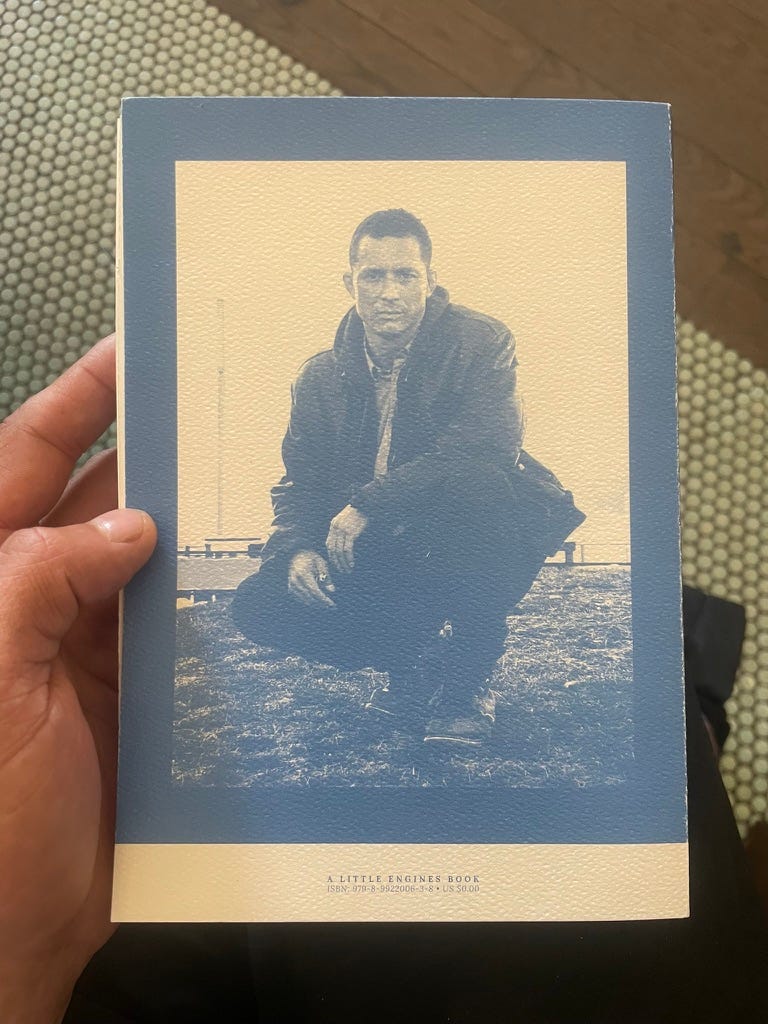
The great AL JACOBS shot the author photo on the back, that was Adam’s idea, I think it looks pretty fucking sick.
Might do some events starting next week if we still have any books left, possibly with a second printing. Hope you enjoy, and thanks for reading.
U shoulda made Adam publish the 300k word version
i waited 30 minutes and refreshed the site at 9 am (im in cali) the walk book was a supreme drop to me . i am very exited to read .